How much interior floor space does a family sized built in oven need?
Oven diameter determines how many pizzas you can cook at once, how much wood you burn, and how long you wait. Here is how to size a built in oven for real life.
Diameter, the fire, and the space that is actually usable
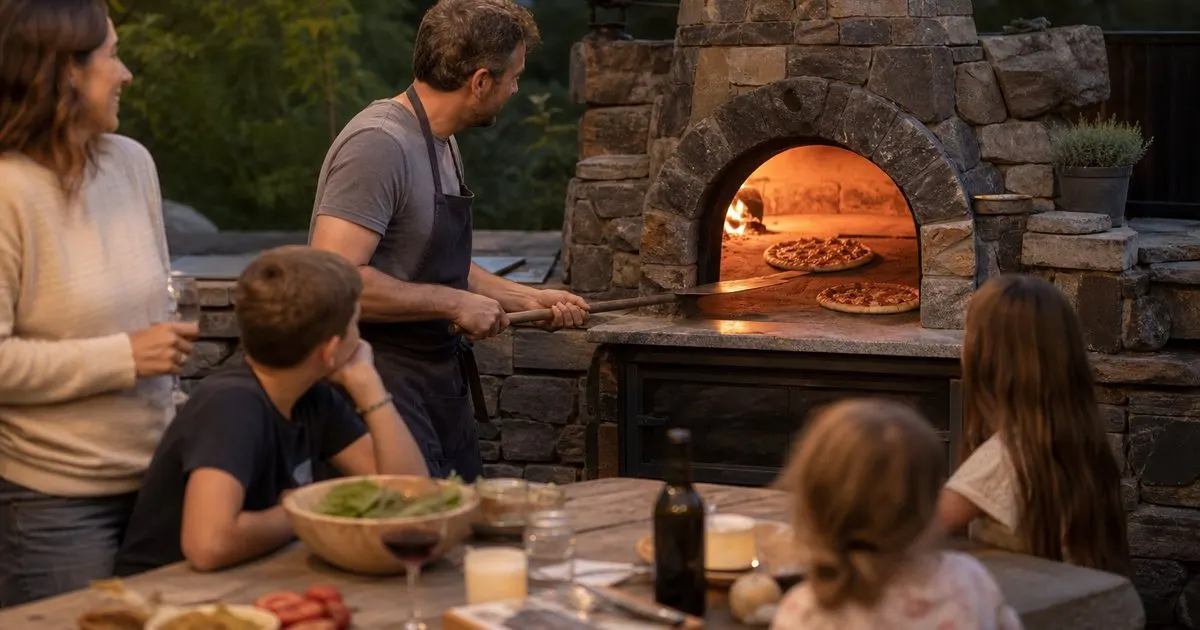
Interior diameter is the number most manufacturers lead with, and it is the right starting point, but it overstates what you can cook. A live fire occupies part of the floor at all times, typically pushed to one side or the back, and pizzas need a margin from the coals so they do not scorch on one edge. The usable cooking area is therefore the diameter minus the fire zone and a working margin, which in practice is roughly a third to a half of the total floor. A 32 inch oven does not cook two 12 inch pizzas comfortably; it cooks one, with room to turn it.
Shape matters as well. Round domes give even heat and are easiest to work with a peel, while oval or rectangular interiors offer more usable floor for the same width because the fire sits at the end rather than eating into the middle. Some premium modular ovens are elongated for exactly this reason, allowing two pizzas side by side in a footprint that a round oven of the same width could not manage. When comparing ovens, ask how many 12 inch pizzas fit at once with a fire burning, not just the nominal diameter. Related: What refractory materials keep a built in pizza oven radiating even heat?
Keep reading: How hot does a wood fired pizza oven need to get for Neapolitan?, Which is better for backyard entertaining, wood fired or gas pizza ovens?, What refractory materials keep a built in pizza oven radiating even heat?. See how Fornaluxe helps you the artisan guide to wood-fired and built-in pizza ovens.
Matching size to how you will cook
For a household that cooks pizza for four to six people and occasionally hosts a few more, an interior in the range of roughly 32 to 36 inches is the sweet spot most owners settle on. It cooks one pizza at a time at full speed, which at Neapolitan temperature is a pizza every couple of minutes, and it heats up in a reasonable time on a sensible amount of wood. Ovens in this range still bake several loaves of bread and take a full roasting pan with room to move it around. Related: How long does a premium pizza oven take to reach cooking temperature?
Households that entertain regularly, with a dozen or more guests on a summer evening, benefit from stepping up to roughly 40 to 48 inches. Two or even three pizzas at once, a whole turkey with side dishes, or a full sheet tray all become practical. The trade off is longer heat up, greater wood consumption, a heavier structure, and a larger footprint in the outdoor kitchen. Ovens above about 48 inches are usually restaurant oriented and rarely make sense at home unless cooking for large groups is the primary purpose. Bigger is not better if it means you fire the oven less often because heating it feels like a project. Related: Which is better for backyard entertaining, wood fired or gas pizza ovens?
What the numbers mean for heat up, wood, and cost
Every additional inch of diameter adds mass to the dome and floor, and that mass has to be heated. A 36 inch oven with a premium thick floor may take roughly an hour to an hour and a half to reach pizza temperature from cold; a 48 inch oven of similar construction will take noticeably longer and burn more wood doing it. That extra mass also holds heat longer for bread and roasting the next day, which is the flip side of the same coin. Consider how often you will use the oven for a quick weeknight pizza versus a long weekend cooking sequence, and weight your decision accordingly. Related: How hot does a wood fired pizza oven need to get for Neapolitan?
Cost scales with size in every direction: the oven itself, the base and enclosure that carry it, the insulation, and the installation labor. A larger oven also needs a larger landing, a heavier foundation, and more room for the door swing and peel handling, all of which add to the footprint of the outdoor kitchen. In the luxury segment, where ovens routinely cost several thousand dollars before installation, stepping up a size can push the total project meaningfully higher. That is money well spent for a family that will use the capacity, and a poor trade for one that will not.
Practical checks before you commit
Lay the oven's footprint out with tape on the patio, including the enclosure and landing depth, and stand where you would cook. Check that the mouth is at a comfortable working height, usually around counter height, and that there is room to swing a long peel without hitting a wall, a post, or a guest. Consider where wood will be stored and where hot ash will go. An oven that looks right on a rendering can crowd a patio in real life, and the reverse is also true.
Then think about the door opening, which is sized in proportion to the dome and limits what you can put inside. A wide mouth admits large roasting pans and sheet trays; a narrow one keeps heat in but restricts you to smaller vessels. Ask the manufacturer for the door width and height, not just the floor diameter. Between those two numbers, the usable floor with a fire burning, and an honest estimate of how many people you actually feed, you can size a built in oven with confidence. Where products in this guide are linked, we may earn a commission; our sizing guidance does not change because of it.
- Usable floor is the diameter minus the fire zone, so a 32 inch oven realistically cooks one pizza at a time.
- Roughly 32 to 36 inches suits most families, while 40 to 48 inches suits frequent large gatherings.
- Larger ovens heat slower, burn more wood, and cost more in base, enclosure, and installation.
- Tape out the footprint, check working height and peel swing, and ask for the door dimensions.

Julien Jimenez
Julien Jimenez is an independent software builder based in Paris. He designs, ships, and operates focused SaaS products for small businesses and independent professionals. Read the full author page.
The Fire at the Center of Every Evening
The artisan guide to wood-fired and built-in pizza ovens. Fornaluxe is built to help you put this into practice.
Choose your ovenMore from the Fornaluxe blog
How hot does a wood fired pizza oven need to get for Neapolitan?

Which is better for backyard entertaining, wood fired or gas pizza ovens?
What refractory materials keep a built in pizza oven radiating even heat?
Get the complete wood-fired and built-in pizza ovens guide
Our full buying guide, the price guide, and new research as we publish it. One email, no spam, unsubscribe any time.