How do you size a chimney flue for a built in wood fired oven?
Flue diameter, stack height, and termination details decide whether a wood fired oven draws cleanly or pushes smoke across your patio. Here is how to get them right before the facade goes on.
Why draft matters more on an outdoor oven than most people expect
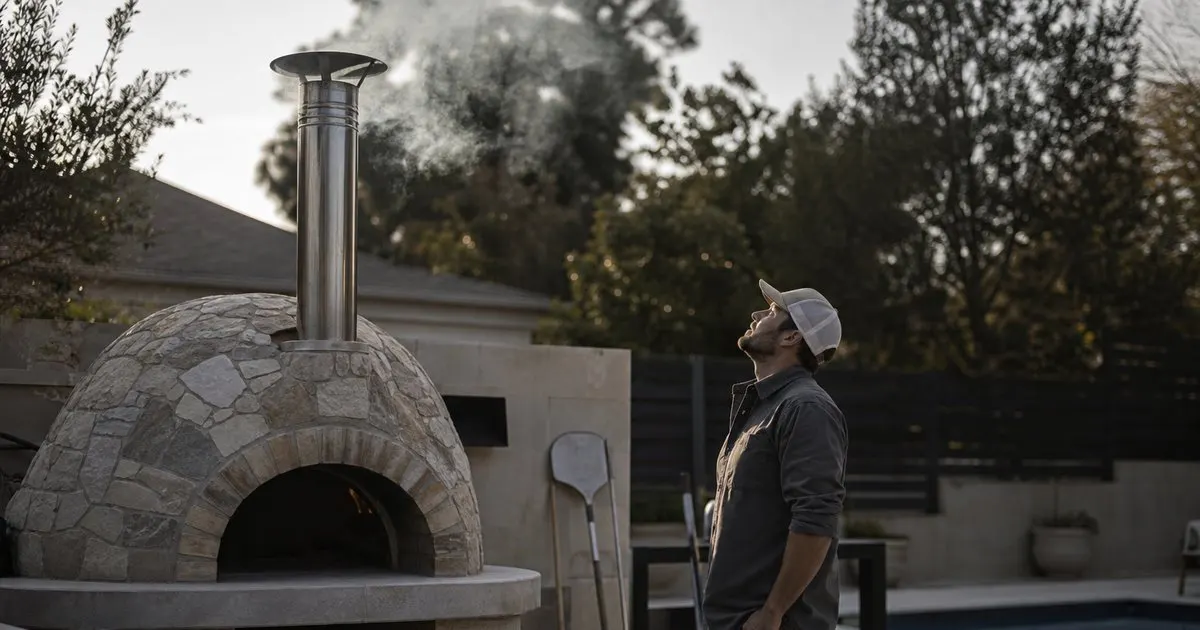
A wood fired oven is a small combustion appliance, and its chimney does two jobs at once. It carries smoke and combustion gases away from the cooking area, and it creates the pressure difference that pulls fresh air across the fire through the oven mouth. When the flue is undersized, or the stack is too short, that pull weakens. The visible symptoms are smoke curling out over the oven landing, soot building on the dome face, and a fire that sulks instead of roaring. On a covered patio or under a pergola those symptoms turn a luxury feature into a nuisance within minutes. Related: How hot does a wood fired pizza oven need to get for Neapolitan?
Oversizing has its own problems. A flue that is far too large for the oven opening lets gases cool before they exit, which reduces draft and encourages creosote to condense on the interior of the pipe. The goal is a chimney matched to the mouth of the oven and the volume of the dome, then run high enough to clear nearby obstructions. Premium modular oven makers publish a recommended flue diameter for each model; treat that as the starting point rather than a suggestion. Related: How long does a premium pizza oven take to reach cooking temperature?
Keep reading: How hot does a wood fired pizza oven need to get for Neapolitan?, Which is better for backyard entertaining, wood fired or gas pizza ovens?, What refractory materials keep a built in pizza oven radiating even heat?. See how Fornaluxe helps you the artisan guide to wood-fired and built-in pizza ovens.
Matching flue diameter to the oven mouth
For most residential built in ovens the manufacturer specifies a flue in the range of roughly six to eight inches in diameter, with larger commercial style domes calling for more. The logic ties back to the oven opening: the flue cross section needs to handle the gas volume passing through that opening at full fire. A well designed oven places the flue collar just outside the door arch, in the vestibule or landing area, so smoke leaves before it can spill forward. If you are working with a mason on a custom brick oven rather than a modular kit, ask for the flue calculation in writing and compare it with what similar sized ovens use. Related: Which is better for backyard entertaining, wood fired or gas pizza ovens?
Material choice affects sizing decisions too. Double wall insulated stainless pipe keeps flue gases hot, which strengthens draft and allows a slightly shorter run to perform well. Single wall pipe cools quickly outdoors and often needs additional height to compensate. Masonry chimneys with a clay or stainless liner behave like insulated pipe once they warm up but take longer to establish draft on a cold morning. Whatever the material, keep the run as straight as possible, since every elbow reduces effective draft and adds a place for soot to collect.
Getting the stack height and termination right
Height is where many otherwise excellent installations fall short. Residential building codes in the United States commonly apply a rule that a chimney must terminate at least three feet above the highest point where it passes through a roof, and at least two feet higher than any portion of the building within ten feet horizontally. Even if your oven sits in open air with no roof penetration, that principle is a useful guide: nearby walls, eaves, and pergola beams create downdrafts that push smoke back into the cooking area. A taller stack sitting well above those obstructions draws better and keeps smoke out of your guests' faces. Related: What refractory materials keep a built in pizza oven radiating even heat?
The termination should include a rain cap and, ideally, a spark arrestor screen, particularly in dry western states where embers landing on vegetation are a real concern. Choose a cap designed for wood burning appliances, since decorative caps made for gas vents can restrict flow. If the chimney runs through a covered structure, use listed roof flashing and a storm collar, and keep the required clearance between the pipe and any combustible framing. Inspectors look closely at these details, and they are the parts of the installation most likely to cause trouble if improvised.
Testing draft before the first real cook
Once the oven is installed and cured, run a small test fire on a calm day and watch the smoke. A healthy chimney pulls smoke up and out within seconds of lighting, with the flame leaning slightly toward the back of the dome as air enters the mouth. If smoke lingers at the arch or drifts out the front, note the wind direction, then repeat on a different day before assuming the chimney is at fault. Persistent spillage usually points to a short stack, an obstruction nearby, or a flue collar positioned too far inside the dome.
Fixes are usually straightforward if caught early. Adding a section of pipe, swapping single wall for insulated pipe, or installing a taller cap often resolves the issue without touching the masonry. More involved corrections, such as relocating the flue collar or enlarging the vestibule, are far easier before the facade stone or stucco goes on. That is one reason we suggest firing an oven several times before finishing its enclosure, even if it means living with an unfinished look for a few weeks. As with any recommendation here, we may earn a commission on products linked from this guide, which never changes what we advise.
- Follow the manufacturer's flue diameter for modular ovens, and ask a mason for a written calculation on custom brick domes.
- Insulated double wall pipe keeps gases hot and draws better than single wall pipe outdoors.
- Terminate the chimney well above nearby roofs, eaves, and pergola beams to avoid downdrafts.
- Test fire several times before finishing the facade so any draft corrections stay simple.

Julien Jimenez
Julien Jimenez is an independent software builder based in Paris. He designs, ships, and operates focused SaaS products for small businesses and independent professionals. Read the full author page.
The Fire at the Center of Every Evening
The artisan guide to wood-fired and built-in pizza ovens. Fornaluxe is built to help you put this into practice.
Choose your ovenMore from the Fornaluxe blog
How hot does a wood fired pizza oven need to get for Neapolitan?

Which is better for backyard entertaining, wood fired or gas pizza ovens?
What refractory materials keep a built in pizza oven radiating even heat?
Get the complete wood-fired and built-in pizza ovens guide
Our full buying guide, the price guide, and new research as we publish it. One email, no spam, unsubscribe any time.